
Mandawa, Painted in Time
A journey through Mandawa and Shekhawati, where frescoed havelis turn a small desert town into one of Rajasthan's most intimate encounters with art and history.
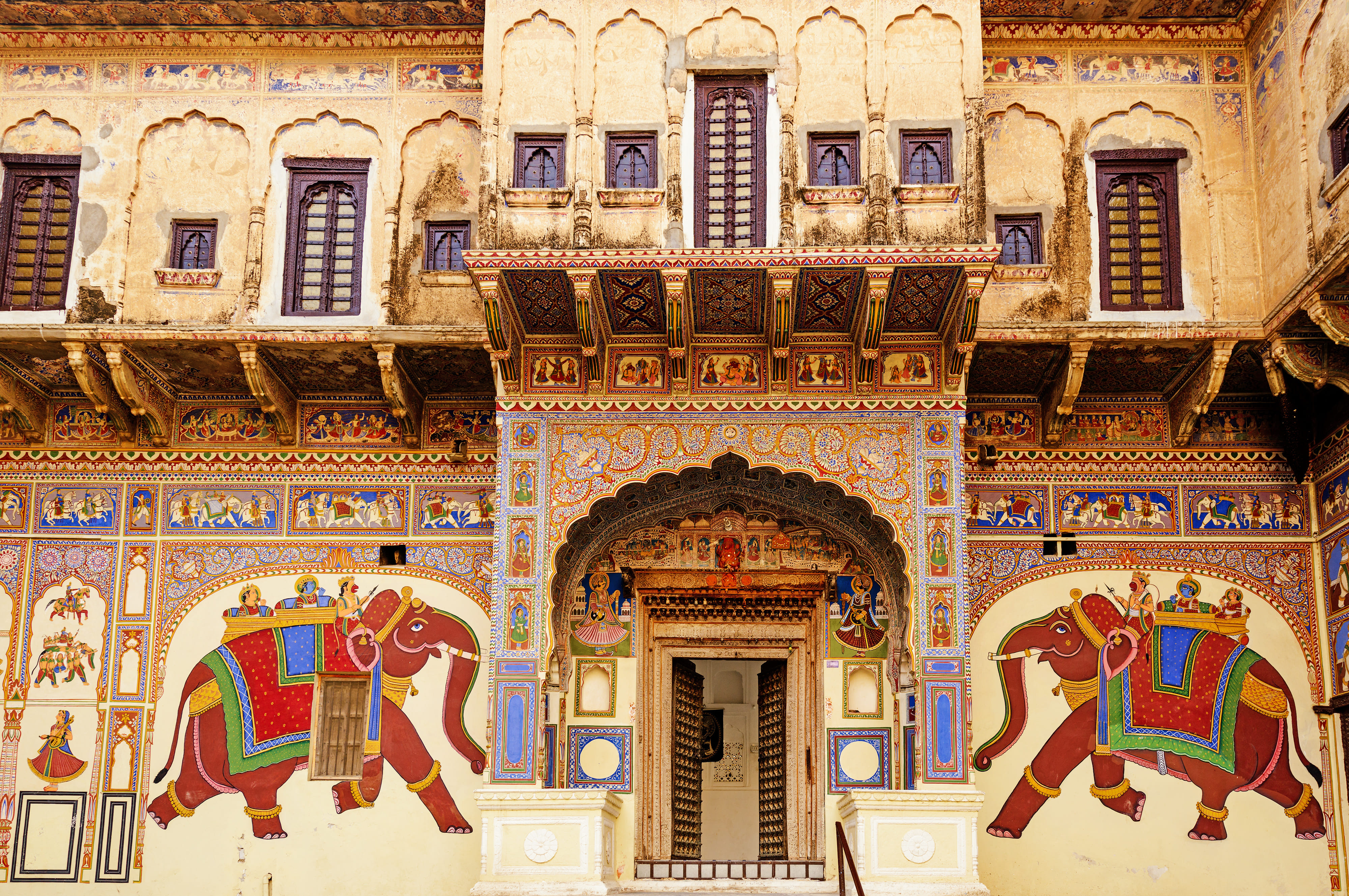
In the Shekhawati region of Rajasthan, walls still carry stories of gods, merchants, machines, fashions and faraway worlds. Mandawa is best explored slowly, one courtyard and painted façade at a time.
A town that asks you to look up
Mandawa does not announce itself with the scale of Jaipur or Jodhpur. Its magic is closer to the ground.
Walk through the lanes and the town begins to unfold across walls: painted façades, carved doors, shaded courtyards and frescoes that seem to appear wherever the eye settles. Some are bright and restored, others are faded, cracked or partly hidden by time. Together they create a kind of open air archive.
Mandawa sits within Shekhawati, a region celebrated for the havelis built by prosperous merchant families from the eighteenth century onward. Their walls became canvases for ambition, devotion, memory and imagination. To wander here is to enter a visual world in which mythology might sit beside a steam engine, a royal procession beside a European figure, a floral border beside an image of modern technology.
When wealth became a wall painting
The merchant families of Shekhawati made fortunes through trade and later through businesses in India's growing cities. Back home, many expressed their success through architecture.
The havelis they commissioned were not simply houses. They were statements of taste, family standing and cultural connection. Courtyards helped regulate heat and privacy. Carved wooden doors marked thresholds. Frescoes covered exterior and interior surfaces with extraordinary density.
What makes the paintings so compelling is their range. Religious scenes sit comfortably beside scenes of daily life. New inventions and foreign influences appear alongside deeply local motifs. The result is not a frozen idea of Rajasthan, but a record of a society looking outward while remaining rooted in its own visual traditions.
The beauty of imperfection
Mandawa's most affecting spaces are not always the most perfectly preserved.
A fading wall can be more moving than a restored one because it makes time visible. Pigment softens. Plaster falls away. A painted figure remains intact while the border around it disappears. You become aware that heritage is not a static object; it survives through use, neglect, repair, memory and sometimes chance.
This is why Mandawa rewards a guide who can do more than point out decorative details. Context changes everything. A painted train becomes part of a story about modernity. A European figure suggests the flow of images and ideas through trade. A courtyard reveals how a large household once lived.
Without that interpretation, the havelis are beautiful. With it, they become fascinating.
A slower Rajasthan
Many journeys through Rajasthan are built around grand monuments. Mandawa offers a different scale.
Here the pleasure is in walking rather than arriving. A doorway leads to a courtyard; a courtyard to a stair; a stair to a painted room. The town is small enough to feel intimate, but visually dense enough to occupy the curious for hours.
There is also time for what larger cities sometimes crowd out: a long lunch, a local shop, a conversation with a caretaker, a quiet rooftop at sunset. The desert light changes the colour of the plaster as the afternoon progresses, and the town feels most atmospheric when you stop treating it as a checklist.
For people who travel through art
Mandawa makes a persuasive case for choosing destinations through an interest rather than a landmark.
For someone drawn to art, architecture, photography or design, the town offers a natural way into Rajasthan's history. You begin with a wall painting and end up talking about trade routes, family fortunes, pigments, social customs and the arrival of new technologies. One curiosity opens another.
This is what passion led travel can do particularly well. It gives the journey a lens. Instead of asking, “What are the top things to see?”, you begin asking, “What do I want to understand?” The difference sounds small, but it changes the entire rhythm of a trip.
The Salori way
Mandawa is a place Salori would approach through looking, listening and context.
A small group can move through the havelis without overwhelming them. There is time to pause over a detail, discuss a motif, photograph a doorway, meet someone who knows the history of a property or simply stand in a courtyard and absorb the quiet.
The most memorable Rajasthan is not always found in its largest palaces. Sometimes it is painted on a wall in a small town, waiting for someone to notice.