
White Horizons, Colourful Souls
We travelled to Kutch for the White Rann, but came back talking just as much about the family who hosted us in Bhuj, the artisans of Ajrakhpur, the history of Dholavira and the many meals we shared along the way.
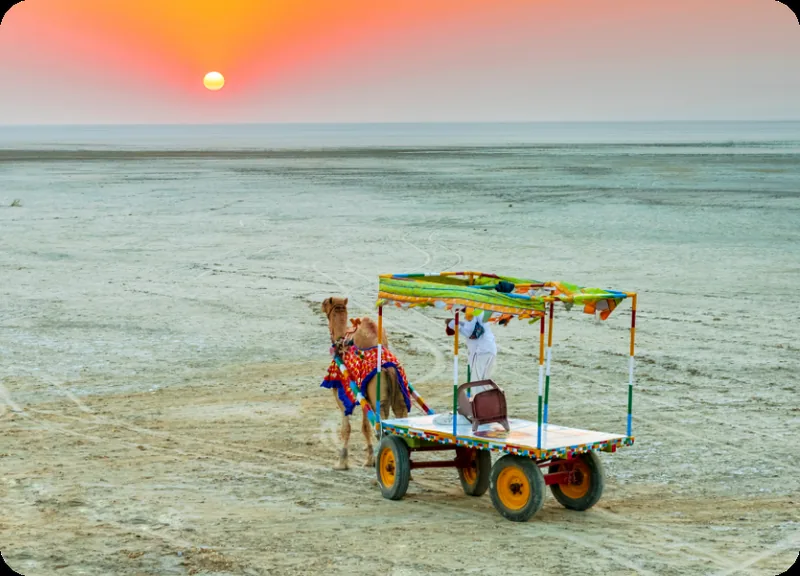
Six days from Delhi through Bhuj, Dholavira, Tent City and the White Rann
TRIP HIGHLIGHTS: Family run stay in Bhuj • Kutchi food • Ajrakhpur block printing and shopping • Smritivan • Dholavira • Tent City • Road to Heaven • White Rann
We left Delhi in November expecting the White Rann to be the highlight of the trip. It was certainly unforgettable, but six days later, when we began looking through our photographs, we found ourselves talking just as much about a family in Bhuj, the food from their kitchen, the artisans of Ajrakhpur and the long road to Dholavira. With only one direct flight between Delhi and Bhuj, half of the first and last days were spent travelling. That is how a four-night trip became six days, and in hindsight the slower beginning and end suited Kutch perfectly.
Our Salori Curator had planned the journey around the many sides of the region rather than only its most famous view. Bhuj gave us local life and hospitality, Ajrakhpur brought us close to a craft we could actually try, Dholavira took us thousands of years into the past, and Tent City opened the door to the border landscape and the White Rann. Our Salori Mentor added the stories and local context along the way, but there was also plenty of room for unplanned stops, longer meals and shopping that lasted much longer than anyone expected.
Bhuj, Served from the Family Kitchen
We spent our first two days in a boutique hotel run by a local family. The rooms were lovely, but what we remember most is how quickly the place began to feel like home. Meals came from the family kitchen, served with the easy insistence that we try a little more of everything. Thepla, dabeli, fafda with jalebi, pakwan and khaman appeared throughout the day. At the same time, dinners introduced us to bajra no rotlo with ringan no olo, sev tameta nu shaak, lasaniya bataka, and khichdi with kadhi. Just when everyone claimed to be full, gulab pak arrived and somehow found space on every plate.
Food made conversations with our hosts feel natural. We heard about Bhuj, its neighbourhoods and its changing life while sitting around the table rather than listening to a formal introduction. During the day, we explored the city, its markets, and museums. Smritivan, the earthquake memorial and museum on Bhujiyo Hill, was the visit that stayed with us most. Created by the Government of Gujarat and inaugurated by Prime Minister Narendra Modi, it tells the story of the 2001 earthquake, but also of what the people of Kutch rebuilt afterward. Once we saw it, the energy of present-day Bhuj felt even more remarkable.
The Afternoon We Lost to Ajrakh
Ajrakhpur was meant to be a craft visit. It became one of the liveliest afternoons of the trip. We watched artisans build complex patterns slowly, pressing carved wooden blocks onto fabric one careful layer at a time. The calm precision made it look easy until we were invited to try. Our own block-printed souvenirs had uneven edges and imperfect spacing, but that only made everyone more attached to them.
None of us planned to shop as much as we did. Once the sarees, skirts, kurtas and stoles came out, there was always one more colour to see and one more piece to unfold. Shopping directly from the artisans changed the experience. We knew how the fabric had been printed, had met the people who made it and understood the patience behind every pattern. By the time we left, several bags were fuller, and at least a few suitcases had become a future problem.
An Ancient City, a Beach and a Long Road
The journey towards Tent City was never treated as a simple transfer. We visited Dholavira, one of the great cities of the ancient Indus Valley Civilisation. Standing among the remains of a settlement planned thousands of years ago gave the landscape a completely different scale. The reservoirs, streets and surviving structures made it easier to imagine that this seemingly remote region had once supported a sophisticated city.
We also stopped by the coast, which felt like an unexpected change after Bhuj and the archaeological landscape. Kutch kept shifting around us, from city streets to craft villages, from ancient stone to the sea, and then gradually towards the open salt country. By the time we reached Tent City, the White Rann still lay ahead, yet the journey had already given us far more than we had expected.
The Road Everyone Wanted to Stop On
Tent City became our base for two nights. Evenings were easy and social, with folk performances, music, local stalls and shared meals. We compared Ajrakh purchases, laughed at our block-printing attempts, and went through the day's photographs together. These weren't grand, planned moments, but they were the ones that brought the group closer. The drive through the border region and along the Road to Heaven was one of the most memorable parts of the trip. The road seemed to run straight into the horizon, with the landscape opening wider on either side. Someone would ask the driver to stop for a photograph, everyone would get back in, and a few kilometres later we would do it all over again.
We had all seen photographs of the White Rann before arriving. Standing there was different. The brightness softened as the sun went down, shadows lengthened across the salt, and the whole landscape changed with the light. For a while, conversation slowed, and even the cameras came down. The White Rann was the image that had brought us to Kutch, but by then it felt like the final scene of a much larger story.
When we came home, we remembered the white horizon. Still, we also remembered breakfast in Bhuj, the pride in the artisans' voices, our imperfect handmade souvenirs, Dholavira, the beach, evenings at Tent City and the many unscheduled stops on the road. Kutch gave us its famous landscape, but its people, food, craft, and history made the journey personal.